Martin Scorsese captures the anger in the zeitgeist once again with ‘Killers of the Flower Moon.’ Projecting the type of American unrest and intensely uneasy feeling that persists. In one of Marty’s most invasive, deeply personal pictures, he personally signs his name with the closing of the film. Speaking to the weight behind this narrative and not undermining it with the dramatics of the picture. He emphasizes the suffering and most importantly, that nothing is seen nor heard and these ideologies continue to live on into the future. It’s arguably Scorsese’s darkest subject matter in his filmography. For a three hour and 26 minute film, it’s incredibly subtle in every sense, as things change over time and don’t always happen in the moment. The town slowly changing or the attitudes toughening. The pacing from editor extraordinar Thelma Schoonmaker is deliberate to show how evil is truly perpetuated on the ground level. It’s not one singular decision, it’s many decisions. All leading to the most heinous, soulless schemes imaginable. Atrocities captured by Scorsese leading us to the emptiness and thoughtfulness of the film’s conclusion. That brings us to Ernest Burkhart (Leonardo DiCaprio), the true son of a bitch that made William K. Hale’s (Robert De Niro) Osage empire stay intact and dangerous.
Ernest is truly a despicable character. Evil to the core and one of the most irredeemable characters I’ve ever witnessed. His vile nature is hidden in niceties and dream speak, no substance, and it’s a thin veil. His part in the mobster machine of the Osage is as wicked as Hale’s masterminding. And most importantly, he terrorizes the mother of his children, the brilliant Lily Gladstone as Mollie Burkhart, to satisfy an old man’s craving for estate money. The crimes perpetrated here are of a genocidal nature and Scorsese hides none of it.
Scorsese’s brilliant team of technicians
With the help of Silence DP and wonderfully talented cinematographer, Rodrigo Prieto, Scorsese’s emotional requiem of pain is captured viscerally through the images. On top of a gorgeous visual component, the sound mix is superb, adding underlying weight to many sorrowful moments. It’s an extremely well-made movie, from the recreation of Oklahoma, to the stylish set designs that make up dialogue scenes. It’s a fully realized town, living and breathing, making the pain of the murders much more impactful. And finally, Schoonmaker keeping a three hour movie moving at an engaging pace – she nails it with an aggressive edit to hammer in the many themes of the screenplay.
It’s not unusual to see Scorsese produce a script with this thematic richness. In one review, there’s no conceivable way to cover all of it in detail from Flower Moon. Starting with the power of the flashing image, and the immediacy of documentation. Followed up by the essence of evil, and how Ernest, who, on the surface, is a well meaning guy, but has no inhibitions and lets his environment direct his actions. The themes are expansive. As Scorsese grows older, so expands the weight of his word and what he’s trying to say about the world.
World class Ensemble
Now, let’s speak to the ensemble. A phenomenal cast highlighted by a special performance from one Lily Gladstone. Exquisitely paced, vibrant, performative mature that underlines her deeply rooted love for family and community. Gladstone handles her character with such grace and the natural reaction to Ernest leading her down the darkest path imaginable is heartbreaking. One of the few issues of the film is her sickness takes Gladstone virtually out of the final two acts, and her presence is missed. As for Leo, it’s one of his best performances in years. Nuanced, subtlety emotional, and genuinely heartfelt, Ernest is a confused character that can’t comprehend his role in Hale’s evil. De Niro, as Hale, is a cartoon villain and he’s quite good in that part. Conniving and omnipresent around town. He hovers around Ernest and Molly, corrupting them at every turn. Even going as far as to commit an act of terrorism with the bombing of Molly’s sister’s house.
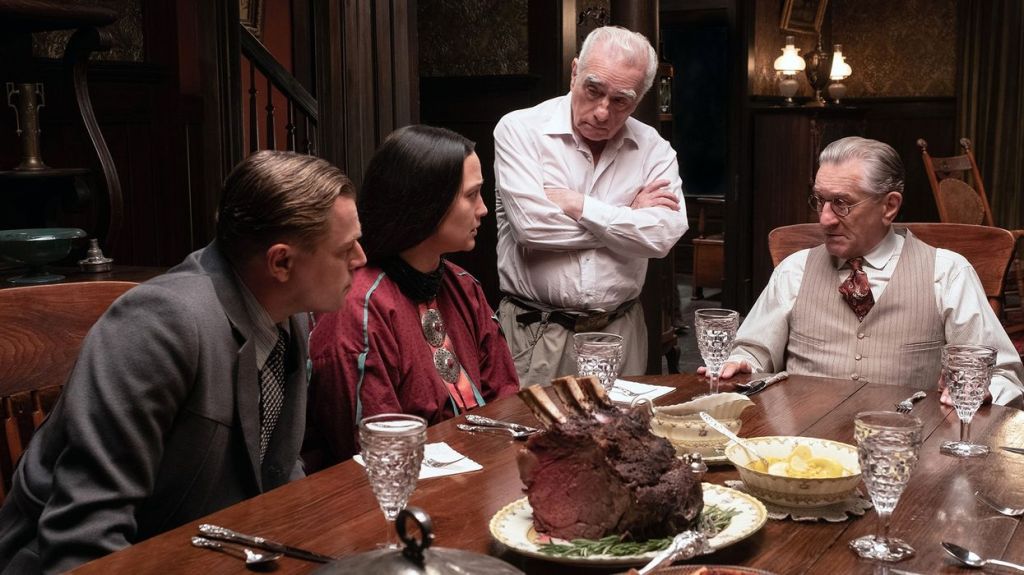
That brings us to Kelsie (Louis Cancelmi) and the gang of dangerous hooligans on the edge of town. Kelsie, an explosive expert, and genuine psychopath. His performance is unhinged. Great job for a smaller role. Moving on, FBI agent Tom (Jesse Plemmons), while entering the story extremely late in the story, delivers a punch with his empathetic nature in a dreary story of mass murder. The run time, while long, earns every second with detailed and thorough examinations of Hale’s schemes.
In closing…
In closing, Killer of the Flower Moon is engaging throughout and a film that will linger on my conscience. When asked if I liked the film immediately out of the theater, I said it needed to marinate, no way could I take that overwhelming experience in one go. The depth is comparable only to the greatest films ever made. When placing this in the pantheon of Scorsese films, hard to say, but of his modern films this is one of his best.
Review: ☆☆☆☆½ (90)
Verdict: not weird


Had such a fantastic experience watching this in the theaters. Loved hearing your thoughts on this!
LikeLike